 English
 Español
 Pусский
 عربي
عربي 


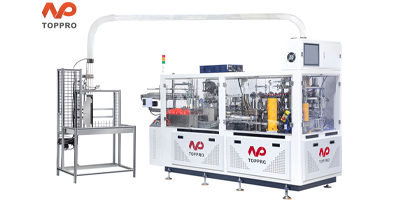
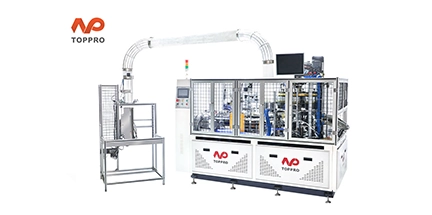
Driven by the rapid development of the food & beverage, takeaway, and catering industries, paper cups have become an indispensable part of daily consumption. As a result, the paper cup manufacturing industry continues to expand, and a wide variety of paper cup machines from different brands are now available on the market. Faced with numerous options, how can manufacturers select a paper cup machine that truly meets their production needs and delivers long-term value? The following key factors provide a clear and practical selection guide.
1. Clarify Production Needs Before Comparing Brands
Understanding your own production requirements is the foundation of correct equipment selection. Without a clear production plan, it is easy to invest in machines that are either underutilized or insufficient for future expansion.
Key aspects to define include:
-
Cup specifications: standard sizes (6oz–22oz) or customized shapes
-
Production volume: expected hourly, daily, or monthly output
-
Paper material compatibility: single PE, double PE, PLA, or biodegradable paper
-
Market positioning: local catering supply, branded chains, or export-oriented production
For small or medium-sized factories, flexible machines with easy mold change and moderate speed can help control risks and costs. For large-scale enterprises, high-speed and fully automatic paper cup machines are better suited to stable, continuous mass production.
2. Focus on Equipment Performance and Manufacturing Quality
Equipment performance is the core of efficient and stable production. A high-quality paper cup machine should combine advanced technology with robust mechanical design.
Key performance indicators to evaluate include:
-
Production efficiency: stable output without frequent stoppages
-
Forming accuracy: uniform cup shape, strong bottom sealing, smooth rim curling
-
Automation level: automatic paper feeding, bottom knurling, rim curling, and cup counting
-
Control system: PLC control, servo motors, and intelligent fault alarms
-
Energy consumption: optimized power usage to reduce operating costs
Machines built with high-precision components and reliable electrical systems tend to offer better consistency, longer service life, and lower failure rates.
3. Evaluate Technical Support and After-Sales Service Capability
A paper cup machine is a long-term production asset, and professional technical support is essential throughout its lifecycle. Strong after-sales service ensures smooth installation, efficient operation, and fast problem resolution.
When assessing suppliers, pay attention to whether they provide:
-
Installation and commissioning support, on-site or remote
-
Comprehensive operator training and technical documentation
-
Fast-response technical assistance for troubleshooting
-
Stable spare parts supply and clear warranty policies
Brands with experienced engineering teams and global service networks can significantly reduce downtime and improve production continuity.
4. Consider Total Cost of Ownership, Not Just the Purchase Price
While budget is always a concern, focusing only on the initial machine price can be misleading. A more practical approach is to evaluate the total cost of ownership over the paper cup machine’s service life.
Cost-related factors include:
-
Initial equipment investment
-
Energy consumption and operational efficiency
-
Maintenance frequency and spare part costs
-
Labor savings through automation
-
Equipment durability and upgrade potential
A reliable, high-efficiency paper cup machine may have a higher upfront cost but often delivers better long-term returns through lower operating expenses and higher productivity.
Summary
Selecting a suitable paper cup machine among numerous brands requires a comprehensive assessment of production requirements, equipment performance, technical support, and long-term cost efficiency. A well-chosen machine not only ensures stable product quality but also supports sustainable growth and competitive advantage in the market.
FAQ
Q1: How do I determine the right capacity for my paper cup machine?
A: Capacity should align with current order volumes while leaving room for future expansion.
Q2: Is it necessary to choose a fully automatic paper cup machine?
A: Fully automatic machines are ideal for high-volume production, while semi-automatic models can be more economical for startups.
Q3: How important is machine material and component quality?
A: Very important. High-quality components improve stability, reduce failures, and extend machine lifespan.
Q4: Can one paper cup machine produce both single and double PE cups?
A: Many modern machines support both, but it is important to confirm material compatibility with the supplier.