 English
 Español
 Pусский
 عربي



A Paper Bowl Machine that runs at 50–60 pieces per minute doesn't have time to compensate for a slow seal. Each bowl gets one pass at each station, and the seam has to be closed before the bowl moves on. You'll see why the side and bottom use different sealing methods, how the open cam and direct bottom feed support that cycle, and where the DW-50's format envelope sits.
What Questions Come Up Before Matching Seal Methods to a Bowl?
Why not use ultrasonic for both the side and the bottom?
Ultrasonic bonding works best on a lapped joint where the energy can concentrate at the interface between two layers of coated paper. The side seam is exactly that: one edge of the fan laps over the other, and the ultrasonic horn presses along that line. The bottom is a different geometry—a flat disc joining a curved wall, where the contact area is wider and the joint isn't a simple lap. The page lists the DW-50 as using ultrasonic body sealing and hot air bottom sealing, which matches each method to the joint shape it handles best.
Does the paper coating change the sealing requirement?
The DW-50 runs 170–350 GSM paper with single or double PE coating, per the page. The PE layer is what actually melts and bonds; the paper substrate provides the structure. A heavier GSM sheet needs more thermal energy to bring the coating at the joint up to bonding temperature, which is where the hot-air bottom sealing earns its place—it can deliver heat across the wider bottom joint without relying on ultrasonic energy transmission through a thick paper stack.
Ultrasonic Side Sealing: Energy at the Interface
The ultrasonic station on the DW-50 bonds the side seam by applying high-frequency vibration at the lap joint. The page lists “EVERGREEN Ultrasonic” as the side sealing configuration, and notes that an encoder controls the ultrasonic working in coordination with the PLC. That encoder feedback is what keeps the ultrasonic energy delivery synchronized with the bowl's position—if the horn fires late or early, the seam gets a weak spot.
The advantage of ultrasonic on the side seam is that the heat is generated at the interface, not conducted through the paper from an external source. The PE coating at the lap line melts and fuses without the surrounding paper absorbing the bulk of the heat. At 50–60 bowls per minute, that localized heating is what allows the seam to set quickly enough for the bowl to move to the next station.
Why the side seam is the harder joint to close
The side seam runs the full height of the bowl wall, so any weak point along that line becomes a leak path. The page describes the DW-50 as using ultrasonic body sealing rather than a hot-air side seal, which matters for consistency: ultrasonic energy is applied mechanically along the seam line, so the bond follows the horn's path rather than depending on hot air reaching every point of a curved lap. At speed, that mechanical certainty is what keeps the seam continuous.
Hot-Air Bottom Sealing: Heat Across the Disc
The bottom joint is a disc joined to the bowl wall, and the page lists hot air as the bottom sealing method. Hot air brings the PE coating on both surfaces to a tacky state before the bottom is pressed into place. Unlike ultrasonic, hot air doesn't require direct contact between a horn and the joint—it heats the surfaces before they meet, so the bonding happens when the parts are pressed together.
The DW-50 also uses a direct bottom paper feeding system, which the page states reduces bottom paper wastage. That detail connects to the sealing method: the bottom disc has to arrive at the sealing station in the right position relative to the hot-air stream and the pressing tool. A direct feed path shortens the distance the disc travels and reduces the chance of it drifting out of alignment before the seal closes.
| Parameter | DW-50 specification |
|---|---|
| Speed | 50–60 pcs/min |
| Paper weight | 170–350 GSM, single or double PE coated |
| Max. bottom diameter | 165 mm |
| Max. top diameter | 185 mm |
| Max. height | 80 mm |
| Bowl angle | 4–8° |
| Side sealing | EVERGREEN Ultrasonic |
| Bottom sealing | Hot air |
| Bottom paper feed | Direct feed, reduced wastage |
| Lubrication | Automatic oil pump with filtration |
| Control | PLC + encoder, touch screen |
| Power | 11 kW, 380V/50Hz 3-phase |
| Weight / dimensions | 3500 kg / 2650×1600×1800 mm |
What the 170–350 GSM range means for the hot-air setting
A 170 GSM sheet reaches bonding temperature faster than a 350 GSM sheet at the same hot-air setting. The page doesn't list a single fixed temperature for the bottom seal—the operator sets it against the paper weight. Running a light sheet at a heavy-sheet setting risks over-heating the coating and distorting the bottom disc; running a heavy sheet at a light-sheet setting leaves the coating under-melted and the joint weak. The GSM range on the page defines the working window, and the hot-air setting follows the stock.
The Open Cam and the Sealing Cycle
The DW-50's core components use an open cam design with a gear motor, per the page. An open cam converts continuous motor rotation into the intermittent motions the sealing stations need—each station acts while the bowl is held in position, then releases as the cam rotates to the next dwell. That mechanical sequence is what allows the ultrasonic horn and the hot-air nozzle to act on the same bowl at different points in the cycle without interfering with each other.
The page also lists automatic oil pump lubrication with filtration. On an open cam running at 50–60 cycles per minute, the cam surfaces and followers are in continuous motion. A lubrication system that meters oil through a filter keeps those surfaces from wearing unevenly, which would show up as timing drift between the sealing stations—a drift that would produce bowls with a good side seam and a weak bottom, or the reverse.
Why the curling, knurling, and heater are separated
The page notes that separating curling, knurling, and heaters from each other reduces machine noise and improves stability compared with older designs. When those functions share a single block, the vibration from one operation feeds into the others. Separating them means the knurling wheel and the heater act on the bowl without the curling motion's vibration disturbing their contact. At high speed, that separation is what keeps the seal quality consistent rather than varying cycle to cycle.
Feeding, Collecting, and the Rest of the Cycle
The sealing stations are only part of the DW-50's cycle. The page lists an automatic robotic arm for collecting finished bowls, with a counting function that reduces packaging labor. The arm gathers the bowls as they leave the machine and counts them into batches, so the output arrives as a counted stack rather than a loose pile that has to be counted downstream.
-
Direct bottom paper feed: shortens the disc's travel to the sealing station, reducing wastage
-
Robotic collection with counting: turns output into counted batches, cutting packaging labor
-
Touch-screen control with PLC: sets and monitors the cycle from one interface
-
Automatic lubrication: keeps the open cam and gear motor running without manual oiling stops
-
Encoder-controlled ultrasonic: synchronizes the horn firing with the bowl position
What the 20-hour running figure implies about the sealing stations
The page lists the DW-50 as capable of 20 hours of stable running per day. That's not a claim about the motor alone—it's a statement about the whole sealing chain. The ultrasonic horn, the hot-air heater, the cam surfaces, and the bottom feed all have to hold their settings through a 20-hour shift. The automatic lubrication and the separated sealing stations are the design choices that support that continuous operation rather than requiring mid-shift adjustment.
Where the DW-50 Fits a Bowl Producer's Line
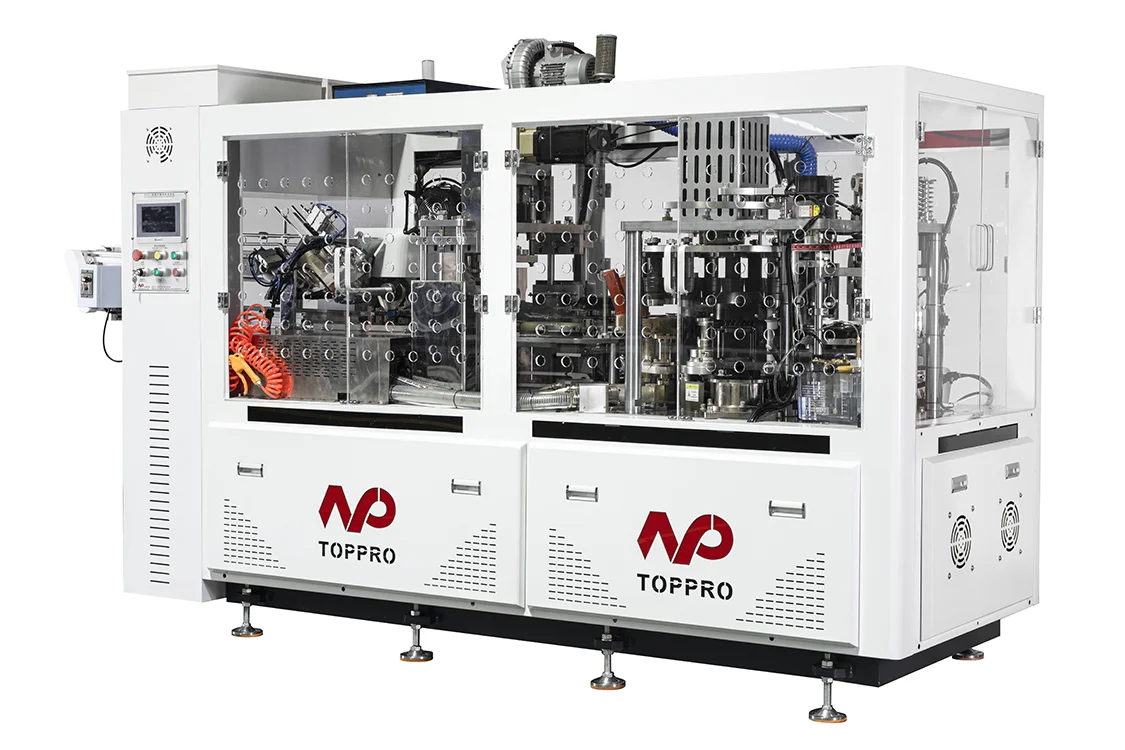
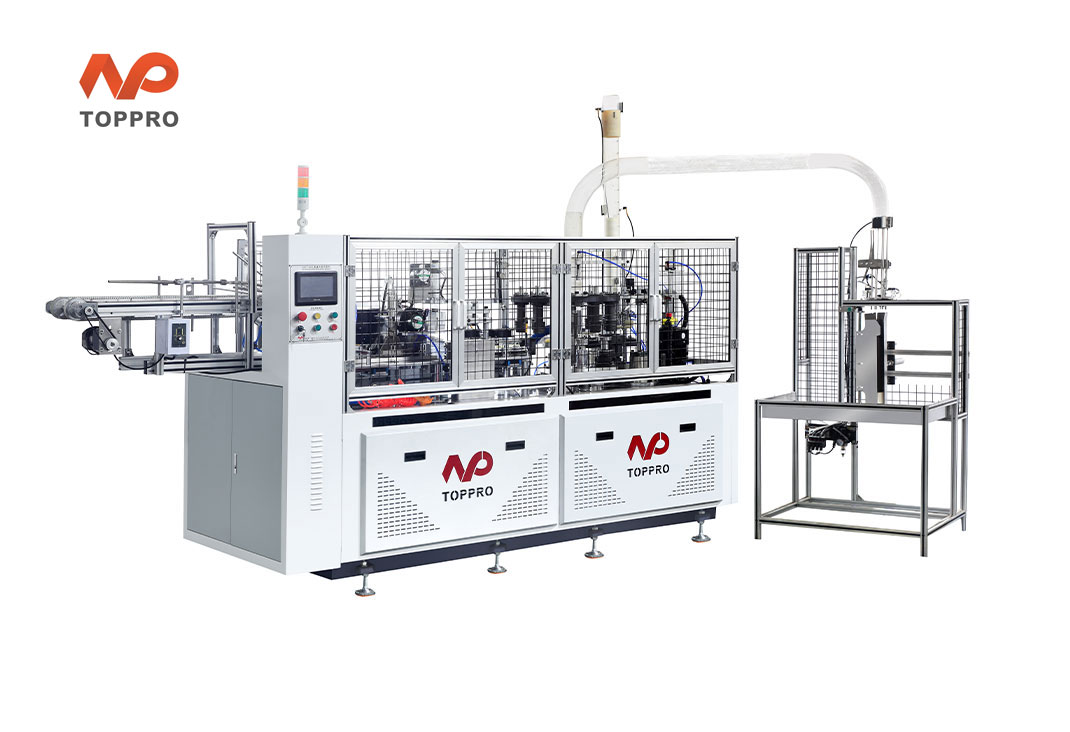
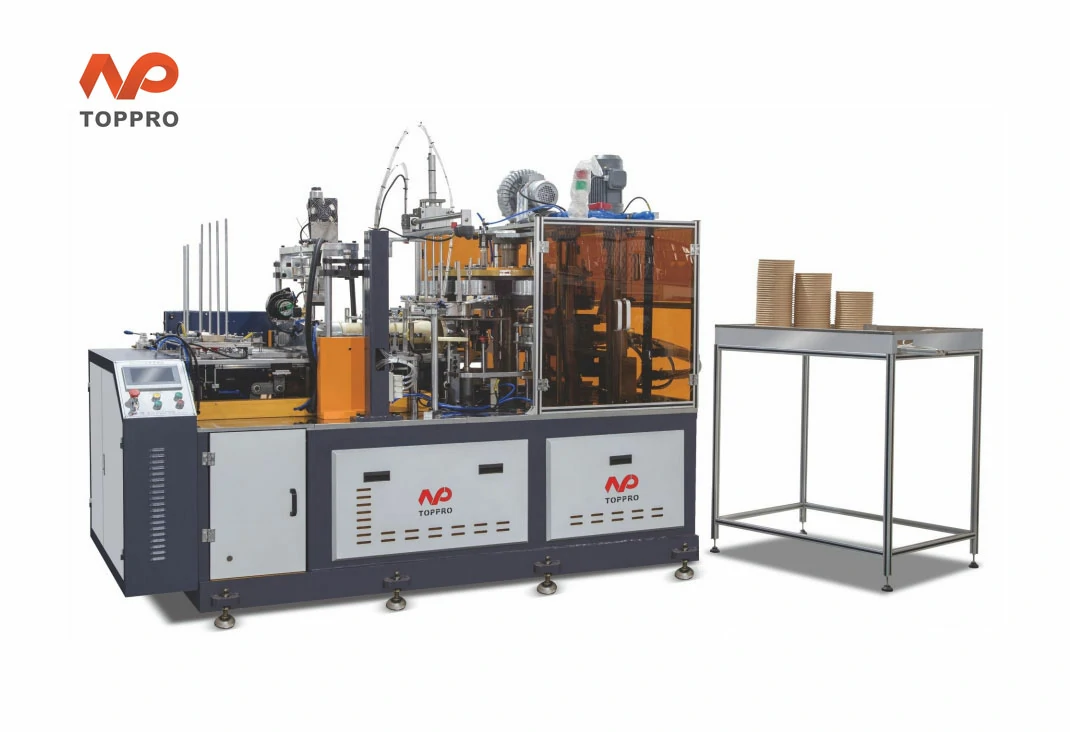
The Disposable Bowl Making Machine from Sincere Machine (TOPPRO Machinery) is built around the split-sealing architecture the page describes: EVERGREEN ultrasonic side bonding, hot-air bottom sealing, a direct bottom paper feed, and an open cam with automatic lubrication, all controlled by a PLC with encoder feedback. The 170–350 GSM paper envelope, the 165 mm maximum bottom diameter, the 185 mm maximum top diameter, and the 80 mm maximum height define the bowl formats it can produce, and the 50–60 pcs/min speed places it in the high-speed tier for disposable bowl production. For a High-Speed Paper Bowl Machine buyer, the value sits in the matching of seal method to joint geometry—the ultrasonic horn handles the lap seam where energy concentration matters, and the hot-air stream handles the bottom disc where wider heating is needed, rather than forcing one method to do both jobs.
What to confirm before matching a bowl format to the DW-50
Confirm the bottom diameter against the 165 mm maximum, the top diameter against 185 mm, the height against 80 mm, and the paper weight against the 170–350 GSM range. The bowl angle of 4–8° is also adjustable, so the format can be tuned rather than fixed. The page's envelope gives the starting point; a trial run on the actual paper stock confirms whether the ultrasonic side seam and the hot-air bottom seal hold together at 50–60 pcs/min.
Let's Check Your Bowl Format Against the DW-50
Send over your bowl dimensions, paper weight, coating type, and target output—we'll help you check them against the DW-50's 165 mm bottom, 185 mm top, 80 mm height, and 50–60 pcs/min speed envelope. Talk to Sincere Machine about your High-Speed Paper Bowl Machine requirements and get a format-level answer before you commit to the line.