 English
 Español
 Pусский
 عربي
عربي 


A plant manager running two shifts of 8oz coffee cups learned it the hard way. The hot‑air machine performed well for the first year, but by the second year, heater cartridges were failing every four to six months. The production line stopped for an hour each time while the machine cooled, the heating elements were replaced, and the side seam was recalibrated. A paper cup machine that uses ultrasonic welding instead of hot air eliminates the most frequent maintenance failure point entirely. Sincere Machinery builds its automatic paper cup machine around a sealed ultrasonic system, step feeding for bottom paper, and pre‑set parameter recall for repeat orders. This guide explains how ultrasonic welding changes your maintenance schedule, why step feeding reduces bottom paper waste, and where the 40‑50 cup‑per‑minute speed rating actually delivers reliable output through a full shift.
Heater cartridges fail on a predictable schedule. Ultrasonic welders do not.
Hot air sealing uses electric resistance heater cartridges to raise the temperature of an airstream, which then melts the polyethylene coating on the paper seam. The cartridges operate at temperatures exceeding 200°C for continuous shifts. After approximately 3,000 to 4,000 operating hours, the resistance wire oxidizes, the internal ceramic insulator cracks, and the heater must be replaced. For a two‑shift operation running 16 hours per day, that means replacing heater cartridges twice per year, with each failure costing an hour of downtime plus parts.
Ultrasonic welding operates on a different principle. A high‑frequency generator sends electrical energy to a transducer, converting it into mechanical vibration at 20‑40 kHz. A horn focuses that vibration directly onto the overlapping paper layers. The rapid friction melts the polyethylene coating at the interface without any external heating element.
Why double PE paper makes ultrasonic welding the better choice
In double PE configuration, where polyethylene coats both sides of the paper, hot air sealing can present challenges. The outer coating facing the heated air melts properly, but the inner coating on the side contacting the forming mandrel does not receive the same heat. Ultrasonic welding bonds the inner coating more effectively because the vibration is generated at the seam interface.
Because ultrasonic welding uses no electric heater cartridges, the “replace heater every six months” maintenance item disappears entirely. The annual maintenance cost for the sealing station on an ultrasonic machine is substantially lower than on a hot‑air equivalent.
Step feeding for bottom paper – why 0.1mm positioning control changes your waste rate
A paper cup fails at the bottom seal before it fails anywhere else. If the bottom disc is not positioned exactly over the heated area, the polyethylene coating does not fully bond, and the cup leaks. On many cup machines, bottom paper feeding is continuous. The paper strip moves through the punch at a constant rate. Variations in tension or timing cause bottom placement to drift over a long run, producing bottom seals that are offset by half a millimetre—visually acceptable but mechanically weaker.
Step feeding changes the control method. The bottom paper advances in discrete steps, each step precisely controlled by a stepper motor that positions the paper to an accuracy of roughly 0.1 mm. The motor halts the paper completely while the punch cuts the disc, ensuring every bottom blank is exactly aligned.
| Control Method | Positioning Accuracy | Waste During Setup | Best For |
|---|---|---|---|
| Continuous feed (friction clutch) | ±0.3‑0.5 mm | High – adjustments during warm‑up | Short runs, single operator |
| Step feeding (stepper motor) | ±0.1 mm | Minimal – preset position saved | Long runs, multiple operators, repeat orders |
How step feeding cuts bottom paper waste on repeat orders
Long runs of coffee cups benefit from step feeding because bottom position consistency holds across an entire shift without operator intervention. For repeat orders of the same cup, the operator recalls the saved bottom feed position from the machine memory, eliminating the setup trial‑and‑error that would otherwise consume the first several dozen cups.
Paper range and cup size – where the 150‑400 GSM spec meets the takeaway cup market
The paper weight range of 150 GSM to 400 GSM covers the full spectrum of single‑use paper cups. Lighter papers in the 150‑200 GSM range are used for ice cream cups, cold drink cups, and small sample cups where structural stiffness is less critical. Medium weight papers from 200‑280 GSM produce standard hot beverage cups for coffee shops, tea houses, and cafeteria use. The heavyweight 300‑400 GSM range is reserved for large‑format cups (16 oz to 24 oz) and double‑wall constructions where the paper must support the weight of a hot fill without buckling.
Single PE vs double PE – what each coating does for your cup
Sincere describes its paper cup machine as capable of running both single PE and double PE paper. Single PE is standard for cups that need only inner moisture protection (cold drinks, ice cream). Double PE adds an outer coating, making the cup resistant to condensation on the outside, which is important for iced beverages in humid environments and for hot drinks where the cup feels drier in the hand.
The machine uses side‑seal sealing technology for the cup body. The side seam is the vertical seal where the fan overlaps. The sealing method (ultrasonic on this model) determines whether the seam remains leak‑proof through the entire temperature range from fridge to boiling water.
The stepping motor versus clutch feed decision that affects your per‑cup material cost
The step feeder on bottom paper reduces bottom paper waste. The contrast with a friction clutch system is significant. A friction clutch uses slip to control tension. As the clutch wears, the slip point drifts, and the bottom paper position changes. An experienced operator compensates by tweaking the tension knob every few hours, but each compensation changes the position of the die cut by 0.1 mm or more, leading to bottom discs that land slightly off‑centre.
A stepper motor bottom feed eliminates the clutch entirely. The controller sends a precise number of pulses to the motor, advancing the paper a known, repeatable distance. The punch fires, the bottom disc drops into the mandrel, and the cycle repeats.
Why a stepper motor pays for itself in material savings alone
When the roll of bottom paper runs out and a new roll is spliced, the operator sets the step position once by aligning the sensor with the printed edge or by entering the stored value from the last run. From that point, every bottom disc lands in the same position. Over a year of production, the reduction in bottom paper waste from stepper control can cover the incremental cost of the motor.
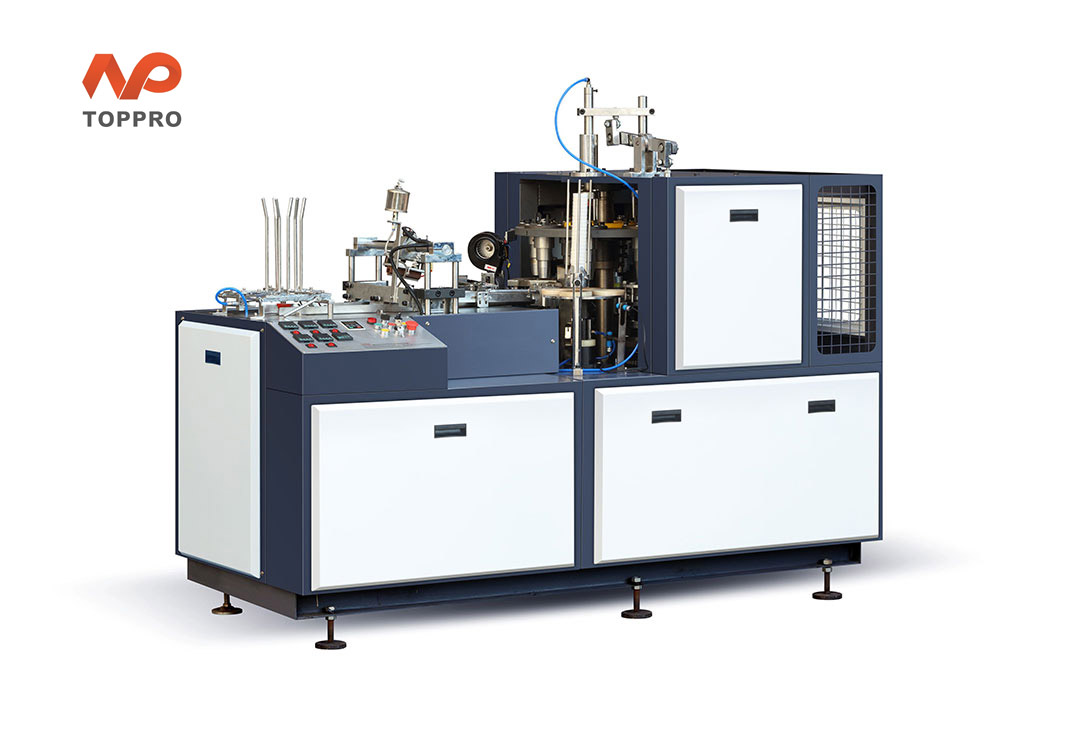
[Image: Close‑up of the bottom paper step feed mechanism on the automatic paper cup making machine, highlighting the stepper motor and the optical sensor for position control]
What the speed rating of 40‑50 cups per minute actually delivers on a production floor
A paper cup machine rated for 100 cups per minute on the spec sheet rarely achieves that speed in a real production environment once you factor in operator breaks, paper roll changes, bottom paper splices, and QC checks.
The Sincere automatic paper cup machine operates in the 40‑50 cup per minute range for its standard output. At 50 cups per minute, the machine produces approximately 24,000 cups per 8‑hour shift assuming continuous running, which is realistic for a two‑operator configuration: one feeding paper rolls and bottom paper, the other packing finished cups.
Why 40‑50 cpm is the sweet spot for labour‑efficient production
Higher speed machines can reach up to 150 cups per minute, but achieving that output requires a fully automated cup‑collecting system and increased operator attention to paper roll changes. For a facility where labour is available cost‑effectively, the 40‑50 cpm range offers a better match between machine capital cost and actual output.
Three reasons a production manager stays with the Sincere automatic paper cup making machine
Reason one: Parameter storage
When a converter runs dozens of orders per month, the time lost reprogramming machine settings for each job accumulates. The Sincere platform stores preset parameters for each cup size and paper type. The operator recalls the job named “8oz coffee cup – double PE – 260 GSM”, and the machine sets the heating temperature, bottom paper step length, and ultrasonic welding time. Changeover drops from forty‑five minutes to fifteen.
Reason two: Step feeding accuracy
The production manager sized the bottom paper waste across his fleet of cup machines. On the clutch‑driven machine, the bottom paper waste rate was about 4% of total paper consumption. On the step‑fed Sincere machine, the waste rate dropped to just over 1%—a difference that, across a 10‑million‑cup year, represents a substantial saving.
Reason three: Ultrasonic sealer management
The hot‑air machine required heater cartridge replacements scheduled on the calendar. The ultrasonic machine uses a power meter to monitor the welder. When the power required to achieve a consistent seal exceeds a set threshold, the machine alerts the operator and allows a condition‑based replacement—not a calendar‑based one.
Where the automatic paper cup making machine fits into a disposable tableware plant layout
Sincere Machinery manufactures paper cup machinery for disposable tableware production lines. The automatic paper cup making machine is placed upstream of cup printing equipment and downstream of paper roll slitting machines. For a plant specializing in coffee cups for chain stores, the line typically includes: paper roll slitter → printing press → cup forming machine → packing station. The Sincere machine fits into the forming stage, taking pre‑printed sheets or roll stock and outputting finished cups.
A paper cup machine that runs reliably with bottom paper step feeding and a sealed ultrasonic welder reduces the two largest variable costs in cup production: material waste (step feeding cuts bottom paper waste by roughly 2‑3% compared to clutch systems) and maintenance labour (ultrasonic welding eliminates the heater cartridge replacement cycle entirely).
【Request a quote from Sincere Machinery】
Contact Sincere Machinery with your target cup size range, weekly production volume, and whether you run single or double PE paper for a machine quotation that includes preset parameters for your specific material.